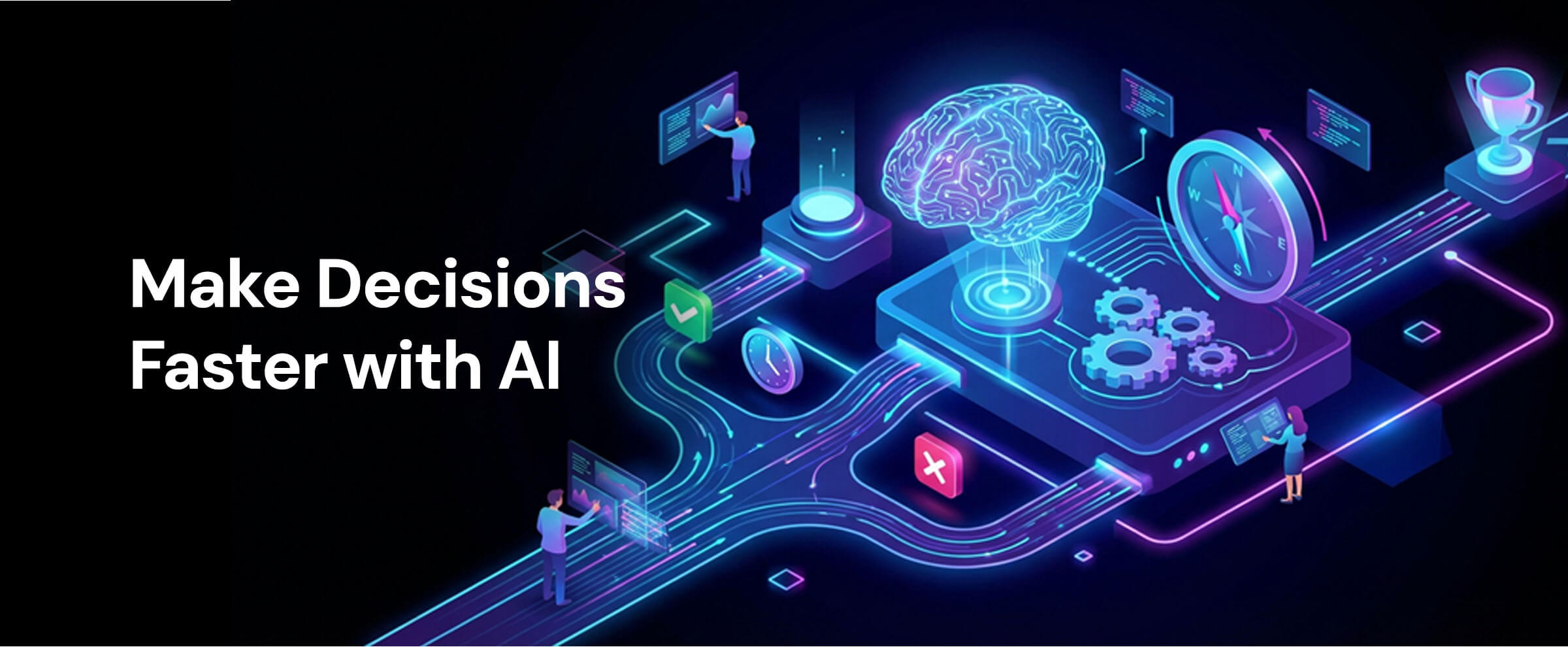
Put yourself in this scenario: It’s Monday morning, and you’re staring at three spreadsheets, two dashboard tabs, and a week-old sales report. You need to decide what inventory items to reorder, re-evaluate your supplier contract, and evaluate how the recent acquisition is going, but the data is scattered across QuickBooks, Hubspot, and your e-commerce platform. You also need to discuss an upcoming pitch with the team but know it might be difficult and timely to get everyone to agree on the initial proposal. By the time you manually piece everything together, it’s Wednesday afternoon.
This isn’t just frustrating. It’s expensive.
Here’s the uncomfortable truth that most business owners don’t talk about: you’re probably making decisions too slowly. And in 2026, slow decisions are the silent killer of competitive advantage.
But here’s the good news: artificial intelligence has fundamentally changed what’s possible. The same AI tools that once cost Fortune 500 companies millions of dollars are now available to small and medium-sized businesses for a few hundred dollars a month. The businesses that figure this out first are making decisions in minutes that used to take days—and they’re winning because of it.
The Real Cost of Slow Decision-Making
Let’s start with what slow decisions are actually costing you. When researchers at McKinsey surveyed over 1,200 executives, they discovered something striking: business leaders spend 37% of their time making decisions, but more than 50% of them believe most of that time is ineffective. Let’s break that down; if you’re working 50-hour weeks, you’re spending almost 20 hours wrapped up in the decision making process, which will ultimately not generate anything productive from 10 of those hours. Over a full business day of time gone.
For a typical Fortune 500 company, what this inefficiency ends up looking like is about $250 million in losses annually. While a small or medium sized business might not feel this impact as a direct hit to revenue like a Fortune 500, you will certainly still feel the effects in other ways. If you’re a small business owner with five employees, you’re probably losing countless hours every year to inefficient processes. Those are hours you could spend reinforcing customer relationships, developing products or team skills, or growing your business.
According to research from Gartner, poor operational decisions cost businesses more than 3% of their profits. For a business doing $1 million in annual revenue with a 10% profit margin, that’s $3,000 in lost profit every year from bad decisions alone. For a $10 million business, it’s $30,000 annually.
But here’s what makes this particularly challenging for SMBs: research shows customers are often up to 70% of the way through their buying journey before they contact you. Modern buyers have already done their research, compared options, and formed opinions. If you don’t fit seamlessly into their timeline — whether it’s about pricing, inventory availability, or customization options — you’ve lost the opportunity before the conversation even begins due to their pre-conversation knowledge.
Slow doesn’t always mean more well thought out.
Now, you might be thinking: “Sure, slow decisions are frustrating, but at least they’re more thoughtful. Isn’t it better to take your time and get it right?”
This is one of the most pervasive myths in business, and the research definitively proves it wrong. McKinsey’s study found something that surprises most people: organizations that make decisions quickly are actually twice as likely to make high-quality decisions compared to slow decision-makers. The key here isn’t just the speed alone; it’s about being a business that can operate at a higher speed. Let’s break down what that entails; to operate fast you have an effective process, rather than one filled with bloat and no clear vision.
To quote the study “organizations that make decisions quickly are twice as likely to make high-quality decisions, compared with the slow decision makers.” Only 20% of organizations excel at decision-making. But in a way that’s also good news; this means a significant portion of your competitors are also making decisions too slowly or with poor quality. There’s a massive opportunity for businesses that can figure out how to decide both quickly and competently.
The research also reveals that organizations with fewer layers of management make better decisions faster. Companies with 1-3 reporting layers see 70% of their decisions rated as high-quality, compared to just 45% at companies with seven or more layers. As an SMB, you already have this structural advantage. With limited overhead and after-motion bloat or red tape, your inherent nimbleness can be flexed to a significant advantage with just the correct players at the table. The question is whether you’re using this.
How AI Changes the Decision-Making Game
This is where AI transforms everything. Traditional business intelligence tools help you create reports faster. AI helps you make decisions faster. There’s a fundamental difference.
Let’s go back to our Monday morning scenario: Without AI, you would need to export sales data from your POS system, pull relevant history from your CRM, check inventory levels in your warehouse management system, review last year’s performance in spreadsheets, calculate profit margins manually, and then take time to evaluate and come to a decision.
With AI-powered business intelligence, you ask a simple question in plain English such as: “Evaluate how the recent acquisition”, “What inventory items might suffer a shortage in the upcoming weeks,” or “compare supplier contracts in detai.l” The AI instantly analyzes your current inventory levels, recent sales velocity, customer purchase patterns, profit margins, and historical performance. In three minutes, you have an answer: “Yes, Product X will likely need to be reordered based on current trends, supplier timelines, and historical purchase volume. You stand to be out of product within 3 weeks, causing a potential drop in customer retention.”
This isn’t theoretical. According to IBM’s study, half of leadership roles surveyed said employees are having more time to spend on things such as creative work & developing new ideas as a direct result of AI adoption.
SMBs Are Adopting AI Faster Than You Think
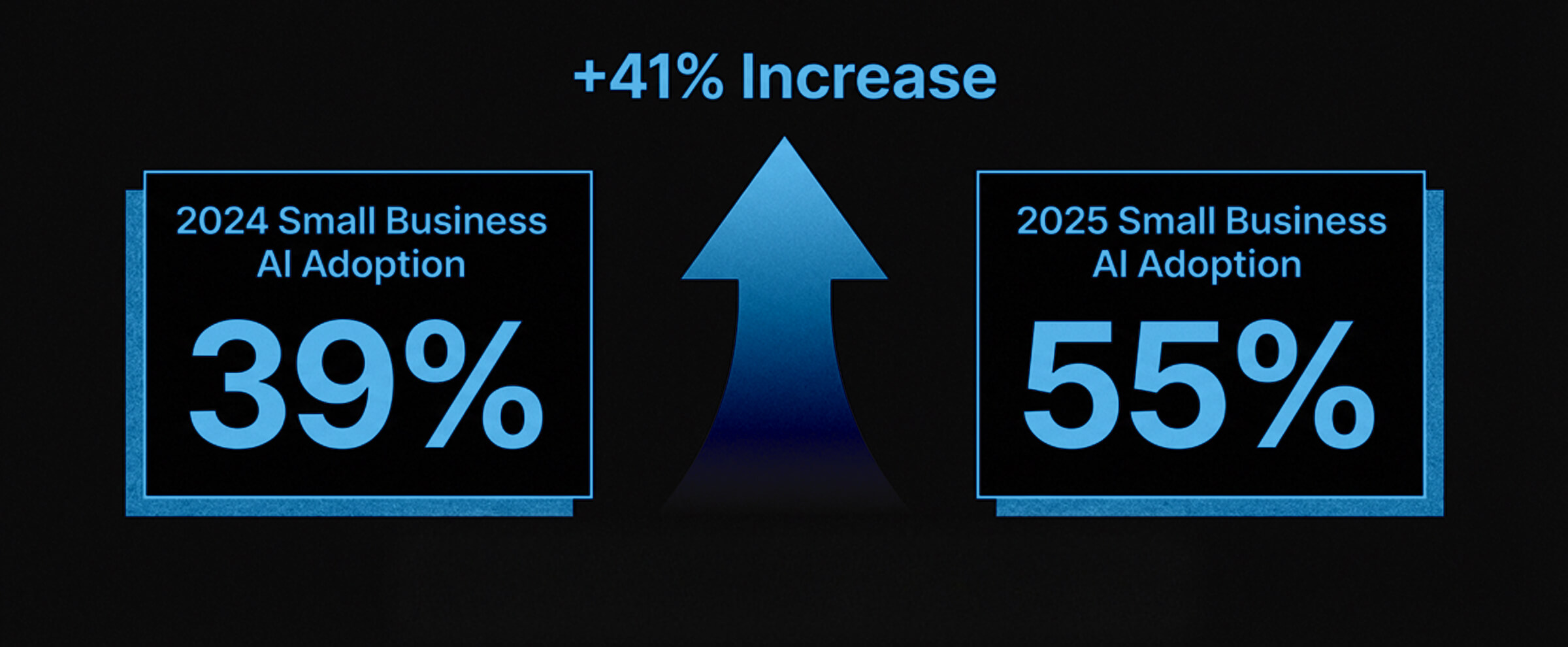
If you’re worried that AI is only for big companies with big budgets, the data tells a very different story. Small business AI adoption jumped from 39% in 2024 to 55% in 2025—a 41% increase in just one year. Mid-sized SMBs with 10-100 employees show even higher adoption at 68%.
Here’s the key; the gap between small businesses and large enterprises is closing incredibly fast. Small businesses reached 8.8% production AI use compared to 10.5% for large enterprises as of August 2025. Historically, small businesses have experienced a lag time behind enterprises when it came to technology adoption. This has been due to a number of factors: financial limitations, management style, or a lack of a realistic use or need at their relative scale. However, when it comes to AI, we are seeing this is not the same.
Ultimately, it comes down to accessibility; AI tools have been fairly affordable after reaching reached widespread availability. Typical SMB AI spending runs about $1,800 per year. That’s $150 per month. Compare that to hiring even a part-time data analyst at $2,000-4,000 per month, and the business justification becomes clear.
Real-World Impact
Circling back to decision making, let’s look at very real areas where AI can and has already benefited in terms of accelerating decision making.
Hiring: Traditional resume screening takes five to ten minutes per candidate. AI processes 1,000 resumes per hour. When you’re hiring for a critical position and receive 200 applications, AI can screen all of them in two minutes instead of 16-20 hours. Organizations using AI for recruiting report 89.6% greater efficiency and 85.3% time savings. More importantly, they reduce time-to-hire by up to 50% while actually improving hire quality—43% report better hires, and AI-selected candidates are 14% more likely to pass interviews.
Pricing decisions: Most small businesses review pricing quarterly or when something feels off. AI enables continuous pricing optimization. Amazon makes 2.5 million repricing decisions daily using their AI. In a wider view, AI has contributed to an estimated gross profit increases of 5% to 10% for companies that have implemented it. You don’t need Amazon’s scale to benefit. AI pricing tools show up to 10% profit margin improvements for SMBs by responding to demand, competition, and inventory levels in real-time.
Inventory management: Running out of your best-selling product because you didn’t reorder in time is a decision failure, not a supply chain problem. AI-powered inventory management reduces stockouts by up to 30% and overstocking by up to 25%. AI-driven demand forecasting reduces forecast errors by 20-50%, cutting lost sales by up to 65%. Instead of deciding when to reorder based on gut feel or fixed schedules, AI tells you exactly when to order and how much based on current sales velocity, seasonal patterns, and lead times.
Marketing budget allocation: Most businesses allocate marketing budgets quarterly and hope they made the right choices. AI shifts marketing budget decisions from quarterly planning sessions to real-time optimization. Instead of discovering three months later that Facebook ads underperformed while Google ads crushed it, AI reallocates budget automatically based on performance. The result: 20-50% better accuracy in budget forecasting and automatic optimization that catches opportunities while they’re still profitable.
The ROI Is Real and Measurable
So we’ve looked at a lot of stats, but up until this point we’ve discussed primarily in terms of optimizing tasks to reduce financial waste. Let’s look now at real opportunities where AI is increasing revenue coming in.
91% of SMBs using AI report it boosts revenue according to Salesforce’s survey of 3,350 small business leaders. That’s not “we think it might help eventually”—that’s “we’re making more money because of this.” Deloitte’s Q4 2024 research found that 74% of organizations say their AI initiatives meet or exceed ROI expectations.
Real-world examples demonstrate the range of returns. A digital marketing agency achieved 500% ROI from AI email automation—a $10,000 investment generated $50,000 in revenue, according to research from Lucid Financials. E-commerce implementations show 20% increases in average order value using AI recommendations, based on a 2025 IDC study.
Even better, AI payback periods have shortened dramatically. Research shows that early adopters now report operational improvements within six months of implementation, compared to the 12-18 month timelines from just a few years ago. That means if you invest in AI decision-making tools today, you’ll likely see positive ROI much faster than businesses did in 2020-2022.
The efficiency metrics tell a similar story: 25% productivity increases, 50-80% error reduction, and 40% reduction in customer acquisition costs with AI marketing tools. When you stack these improvements across multiple business functions, the compound effect creates substantial competitive advantage.
Case Study Time
Let’s look at some concrete examples of small businesses that transformed their decision-making speed with AI.
Ad-flex Communications, a small marketing agency, implemented AI that analyzes ads across 49,000 different dimensions. The result: 81% lower cost per result and 439% higher conversion with the same advertising spend. AI didn’t end up costing them more money—they just made better decisions about which ads to run and when, resulting in an ROI improved by more than 4x.
Geoship, a fast-growing small business, implemented AI resume screening integrated with their existing tools. They saved over 20 hours per hire, reduced hiring costs by 40%, and achieved 2x faster onboarding. For a small team where every hire matters enormously and being a “man down” so to speak can put real pressure on the team and the business as a whole, being able to make hiring decisions twice as fast with better results is everything.
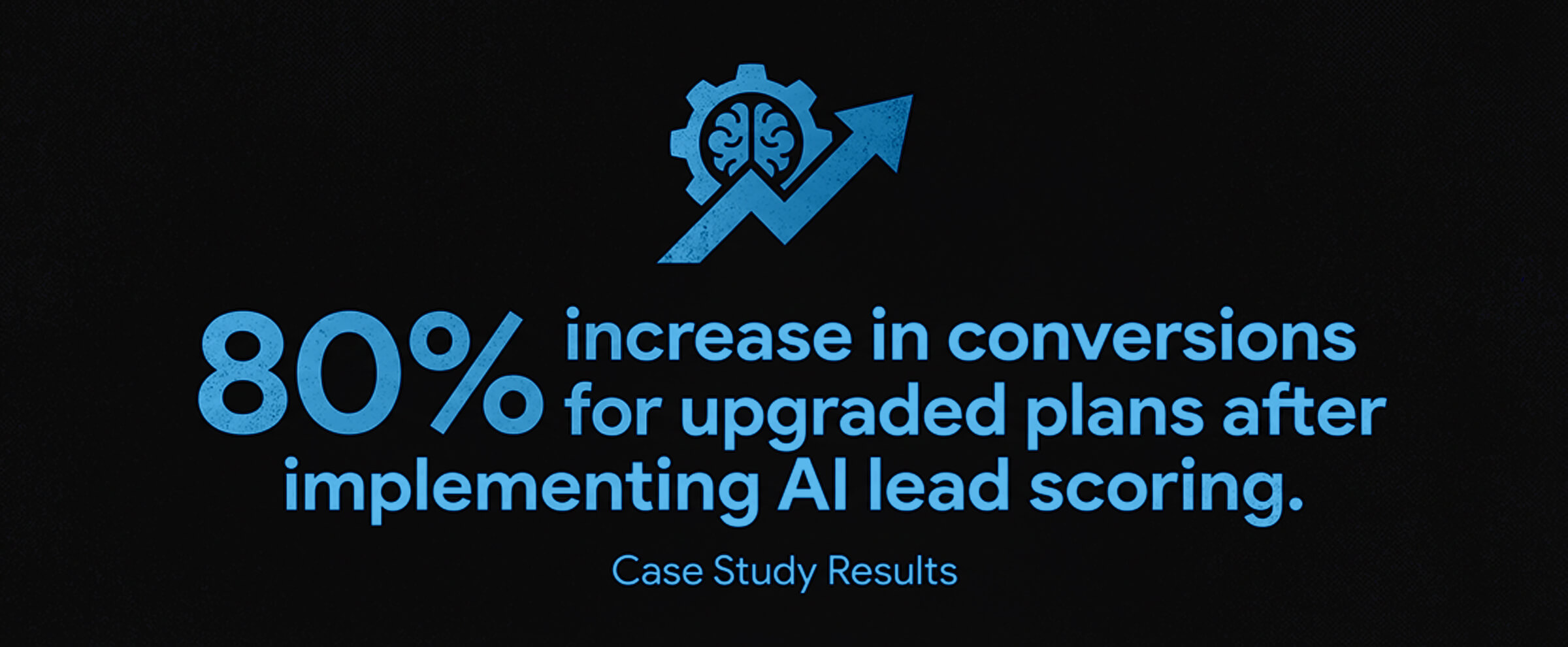
Grammarly, the AI-powered writing assistant used by millions globally, implemented AI lead scoring and achieved an 80% increase in conversions for upgraded plans. After implementing an AI to monitor their product, it automatically evaluated for behavioral patterns, and found that they could predict upgrade intent; a correlation that had previously gone unnoticed. The AI discovered that users who corrected specific types of errors or created particular document formats showed significantly higher upgrade probability than those with superficially similar usage patterns. As a result, Grammarly cut its sales cycle from 60-90 days down to just 30 days—cutting deal time in half while simultaneously improving conversion rates.
Getting Started: The Right Way to Implement AI Decision-Making
So at this point, if you’re convinced that AI can help you make faster, better decisions, your next question is probably about the next step; how is this getting implemented? Here’s some tips to get started:
Start by identifying pain points, not technology.
The most successful AI adopters don’t ask “What can AI do for us?” They ask “What decisions are we making too slowly or poorly?” Identify one high-volume, repetitive decision category where speed would create obvious value. Manual reporting, inventory monitoring, customer acquisition —pick something where you’ll know within 90 days whether it’s working.
Redesign the process, don’t just automate it.
McKinsey’s research shows high performers are 3x more likely to fundamentally redesign workflows around AI capabilities rather than simply automating existing processes. If your current decision process involves exporting five spreadsheets and manually comparing them, don’t use AI to export the spreadsheets faster. Use AI to eliminate the need for spreadsheets entirely by analyzing the underlying data directly.
Make it a leadership priority.
High-performing organizations are 3x more likely to have senior leaders demonstrating visible AI commitment. This doesn’t mean you need to become an AI expert. It means you need to signal clearly that faster, better decisions matter, that AI is going to help achieve them, and that you want yourself and your team to embrace these tools.
Keep humans in the loop.
The goal is empowerment, not replacement. Research shows hybrid human-AI collaboration delivers the highest customer satisfaction and ROI compared to AI-only or human-only approaches. 93% of hiring managers say human judgment remains essential even with AI screening. AI handles volume and velocity; humans provide judgment and creativity. The combination is more powerful than either alone.
What Business Intelligence Looks Like in 2026
The business intelligence landscape has transformed dramatically over the past few years, and understanding what’s now possible helps contextualize how much faster decisions can happen.
Traditional BI meant static reports updated daily or weekly, requiring IT or data analysts to build, and needing SQL or technical skills to use. Modern AI-powered BI means interactive dashboards updating in real-time, self-service access for anyone in the company, and natural language queries where you type questions in plain English.
The speed improvements are dramatic. T-Mobile processed 11x more requests in real time using Power BI’s automation capabilities. Companies migrating from traditional to AI-native platforms report a surge in queries and an increase in analytics adoption—people actually use it because it’s finally easy enough.
Natural language querying represents the next frontier. Forrester predicts that by 2026, every BI tool will offer natural language queries as standard. Early adopters report a 74% increase in self-service analytics adoption within six months of implementation. When people can ask “Which customers haven’t ordered in 60 days?” instead of learning SQL, they actually ask the questions that lead to better decisions.
The Competitive Window Is Open (But It Won’t Stay Open Forever)
Not to repeat ourselves, but perhaps the most important insight from all this research is again this statistic; only 15-20% of organizations currently excel at decision-making. That means a majority of your competitors are making decisions too slowly, with poor quality, or both.
This creates a massive opportunity for SMBs willing to embrace AI-powered decision-making. You don’t need to be perfect—you just need to be better than the 80% who haven’t figured this out yet. And because you’re smaller and more agile than large competitors, you can implement these tools faster and see results sooner.
But this window won’t stay open forever. AI adoption is on the hottest topics of the past year for business, and we don’t see it cooling down here at the start of this year. Your competitors are figuring this out. The question is whether you’ll be among the early movers who gain competitive advantage, or among the laggards trying to catch up later.
The good news: AI tools are accessible, ROI is proven, and implementation can happen in weeks rather than months. The technology is ready. The business case is clear. The only question is whether you’re ready to make decisions at the speed modern business requires.
Take the Next Step: Use AI to get these results for your SMB
Reading about AI capabilities is one thing. Seeing your own business data transformed into actionable insights is another entirely.
That’s why we built ROAI —an AI business platform designed specifically for small and medium-sized businesses. We integrate with Hubspot, Quickbooks, Gmail, Outlook, Shopify, Stripe, Google Drive, Odoo, Paypal, Sharepoint and Woocommerce.
Here’s what you get:
- Simple integrations – Connect in under 60 seconds
- Automatic daily insights – Wake up to a dashboard showing what matters
- Plain-English questions – “Show me my most profitable products”
- Cash flow forecasting – Know what’s coming 30-90 days ahead
Connect your data and see what real insights AI discovers about your business.