Every business collects data. Sales numbers, customer information, expenses, website traffic, inventory levels—the list goes on. But often the reality is that abundance is overwhelming; most business owners have beyond a usable amount of data and need insights rather than just a sheer stockpile of information. You just don’t have the time, tools, or expertise to turn it into decisions.
That’s the problem AI-powered business intelligence solves. And if you’re not using it yet, you’re competing at a disadvantage against businesses that are.
What Is AI-Powered Business Intelligence?
Business intelligence (BI) has been around for decades. Traditional BI takes your business data and creates reports, dashboards, and visualizations. It answers questions like “What happened?” and “When did it happen?”
AI-powered business intelligence takes it to the next level: it tells you why things happened, what will happen next, and when you might expect that to happen.
Let’s break it down:
Traditional BI: “Sales dropped 15% last month.”
AI-Powered BI: “Sales dropped 15% last month because your top-performing product went out of stock on the 12th, your second-best sales rep was on vacation, and website traffic from paid ads decreased 23% while organic traffic stayed flat. Based on current inventory levels and historical patterns, sales will recover to normal levels within 8 days. Consider increasing inventory orders by 20% to prevent future stockouts.”
The example speaks for itself. If you’ve ever wished your data could just speak to you, this is about as close as you’re gonna get.
The Five Critical Benefits of AI-Powered Business Intelligence
1. Reduce Decision Making Time to Minutes
Without AI, creating a comprehensive business report looks like this:
Monday morning ritual:
- Export data from QuickBooks (15 minutes)
- Pull sales reports from Hubspot (10 minutes)
- Download e-commerce data from Shopify (10 minutes)
- Check website analytics in Google (15 minutes)
- Manually combine everything in Excel (45 minutes)
- Analyzing for trends and patterns (30 minutes)
- Outline the path for your next steps forward (20 minutes)
Total time: 2+ hours
By the time you finish, you’re making decisions based on week-old data, and you’ve spent Monday morning on reporting instead of actually running your business.
With AI-powered BI:
Open your dashboard. See real-time insights. Make a decision. Total time: 3 minutes.
AI automatically pulls data from all your systems, analyzes thousands of data points, identifies patterns you may have never spotted manually, and presents exactly what you need to know.
The time savings alone pay for the platform. But the real value? Making better decisions faster than your competitors.
2. Spot Sparks Before They Become Fires
Traditional reporting tells you what already happened. By the time you see that cash flow is negative or a major customer stopped ordering, the damage is done.
AI monitors your business continuously and alerts you to problems while they’re still fixable:
Cash flow warning: “Based on current receivables and upcoming expenses, you’ll have a cash shortfall in 18 days unless you collect payment from ABC Corp or delay the equipment purchase scheduled for March 3rd.”
Customer churn signal: “DataTech Inc. (your #4 customer by revenue) hasn’t logged in for 21 days and declined their last two meeting invites. Historical data shows this pattern precedes cancellation in 78% of cases. Recommend immediate executive outreach.”
Inventory alert: “Your best-selling product (Item #447) will sell out in two weeks based on current velocity. Your supplier has a 10-day lead time. Order now to avoid stockout.”
Fraud detection: “Expense pattern anomaly detected. Travel expenses increased 340% in March vs your 18-month average. Investigation recommended.”
The key here is the proactive rather than reactive nature of AI. Your data is helping you get ahead of itself, in a positive way.
3. Predict What Comes Next with Accuracy
Human intuition will always be invaluable and should be at the core of all your decisions, but in terms of sheer volume AI excels in comparison. It can look at hundreds of variables simultaneously and trim your workflow considerably.
Revenue forecasting: Instead of guessing or using simple averages, AI analyzes your historical data, seasonal patterns, current pipeline, marketing activity, and economic indicators to predict revenue.
“Based on current pipeline strength (73 active deals, average close rate 42%, average deal size $6,200) and historical March performance, projected revenue is $187K-$203K.”
Inventory optimization: AI learns your sales patterns and predicts exactly when to reorder inventory, preventing both stockouts and overstock:
“Product A sells 47 units/month with 15% variance. Current inventory (156 units) will last 3.2 months. Optimal reorder point: when inventory reaches 60 units (approximately May 12th).”
Customer lifetime value: Know which customers will be most valuable over time, not just who spends the most today:
“Customers acquired through organic search have a 2.3x higher lifetime value ($14,200 vs $6,100) than customers from paid ads, despite lower average first purchase amount.”
Seasonal planning: AI identifies seasonal patterns you might miss:
“Your revenue increases 34% in Q4 every year, but expenses typically increase 41%. This year, cap expense growth at 30% to improve profitability.”
4. Connect the Dots Across Your Entire Business
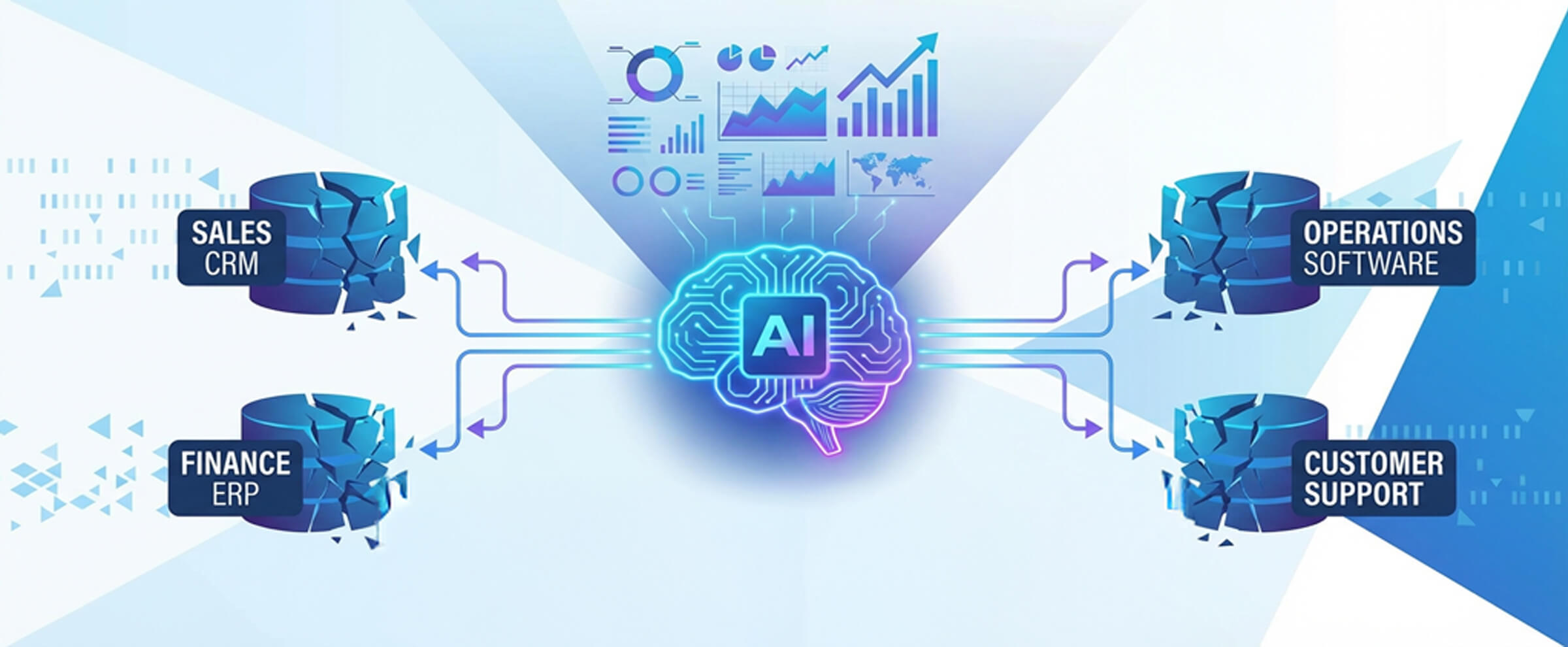
Often, modern business data lives in multiple systems, with each part running a critical part. AI can bridge this gap and paint a complete picture. By connecting to the database of each of your programs, and then cross analyzing you can see real benefits. Let’s look at some examples.
Cross-system insight: “Your email marketing campaigns generate 340 leads per month, but only products with 15+ units in stock convert those leads to sales. When featured products drop below 10 units, conversion rates fall 58% even though ad traffic remains constant. Current inventory reorder triggers are set at 5 units. Recommendation: Integrate marketing calendar with inventory alerts—pause campaigns when stock falls below 12 units and increase reorder triggers to 20 units for promoted products.”
Marketing attribution: “Your Facebook ads drive traffic to mid-price-range products ($150-$300), generating 450 clicks per week. However, analyzing QuickBooks data reveals these products have 12% margins. Meanwhile, organic search traffic gravitates toward premium products ($500+) with 34% margins. Facebook leads require an average of 4.2 support interactions before purchase; organic leads require 1.1 interactions. True cost per acquisition: Facebook $87 (ads + support time), Organic $12 (support time only). Recommendation: Shift ad spend to retargeting campaigns for high-margin products while investing in SEO for premium category terms.”
Operational efficiency: “Customers who receive shipments within 48 hours spend 41% more on their next purchase and place repeat orders 23 days sooner. Your warehouse processes 89% of orders within this window—except for orders containing products stored in Zone C (furthest from packing station). Zone C products add 2.3 days to fulfillment and reduce repeat purchase rates by 19%. These slower-shipping products generate 31% of your support tickets (‘where’s my order?’). Recommendation: Relocate your top 40 Zone C SKUs (by sales velocity) to Zone A, projected to increase repeat purchase revenue by $47,000 quarterly while reducing support costs.”
These insights require analyzing data across multiple systems simultaneously—something humans simply can’t do at scale.
5. Level the Playing Field Against Larger Competitors
Big companies have data teams, business analysts, and million-dollar BI implementations. They’ve been making data-driven decisions for years.
Small and medium-sized businesses historically couldn’t compete on analytics. You didn’t have the budget for enterprise software or the staff to run it.
AI changes everything.
For $150-400/month, small businesses now have access to analytics capabilities that would have cost $100,000+ just five years ago. The AI does the work that previously required a team of analysts.
What this means:
A 15-person company can make decisions as data-driven as a 1,500-person company. You can spot trends as quickly, forecast as accurately, and optimize as precisely.
The competitive advantage that large companies held is evaporating. The question is: will you take advantage before your competitors do?
Real-World Impact: What Businesses Discover with AI-Powered BI
When businesses first implement AI-powered business intelligence, they may be able to discover all sorts of insights, such as:
Revenue opportunities they were missing:
- Customer segments they weren’t targeting
- Products they should be promoting more
- Pricing optimizations that increase margin
- Upsell opportunities they were ignoring
Expenses they shouldn’t be incurring:
- Marketing channels with negative ROI
- Operational inefficiencies costing thousands monthly
- Vendors charging above-market rates
- Software subscriptions no one uses
Risks they weren’t aware of:
- Customers likely to churn
- Cash flow problems on the horizon
- Inventory stockouts coming
- Fraud or errors in financial data
Process improvements that make everything easier:
- Automation opportunities
- Workflow bottlenecks
- Training gaps on the team
- Tools that should be replaced
Common Objections (And Why They’re Wrong)
“My business is too small for BI”
This is backwards. Large businesses can afford to make data mistakes—they have a buffer. Small businesses can’t. Every dollar, every customer, every decision matters more when you’re smaller.
AI-powered BI is actually more valuable for small businesses because the ROI is immediate and measurable. You’re not trying to optimize a billion-dollar operation—you’re trying to not waste money on the wrong marketing channel or miss a cash flow crisis.
“I don’t have time to learn a new system”
AI-powered BI saves you time, it doesn’t consume it. The systems are designed for busy business owners who don’t have time to become data experts.
You ask questions in plain English: “Why did sales drop?” or “Which customers are most profitable?” The AI does the analysis and gives you answers.
Most platforms are easier to use than your current tech stack. If you can check email, you can use AI-powered BI.
“The data will tell me what I already know”
You know your business well. But you don’t know the 10,000 micro-patterns in customer behavior, or the seasonal trends that shift by 3% each year, or which of your 47 marketing campaigns actually drove revenue vs which just drove clicks.
Every business that implements AI-powered BI discovers things they didn’t know. Usually within the first week.
“It’s too expensive”
Regular maintenance and oil changes is cheaper than replacing the engine on your car, but you have to still spend money on the oil.
Making one bad $10,000 marketing decision costs far more than a year of AI-powered BI. Missing one cash flow crisis could put you out of business. Losing a major customer you could have retained will cost thousands in acquisition costs to replace them.
The question isn’t whether you can afford AI-powered BI. It’s whether you can afford to keep making decisions without complete information.
“My industry is too unique”
Every business thinks their industry is special. And you’re right—it is unique.
But data analysis principles aren’t. Whether you’re selling software, running a restaurant, operating a retail store, or providing professional services, you need to know:
- Which customers are profitable
- Which marketing works
- Where you’re wasting money
- What’s coming next
AI adapts to your specific business patterns. It learns what’s normal for YOU, not for some generic business model.
What to Look for in AI-Powered BI
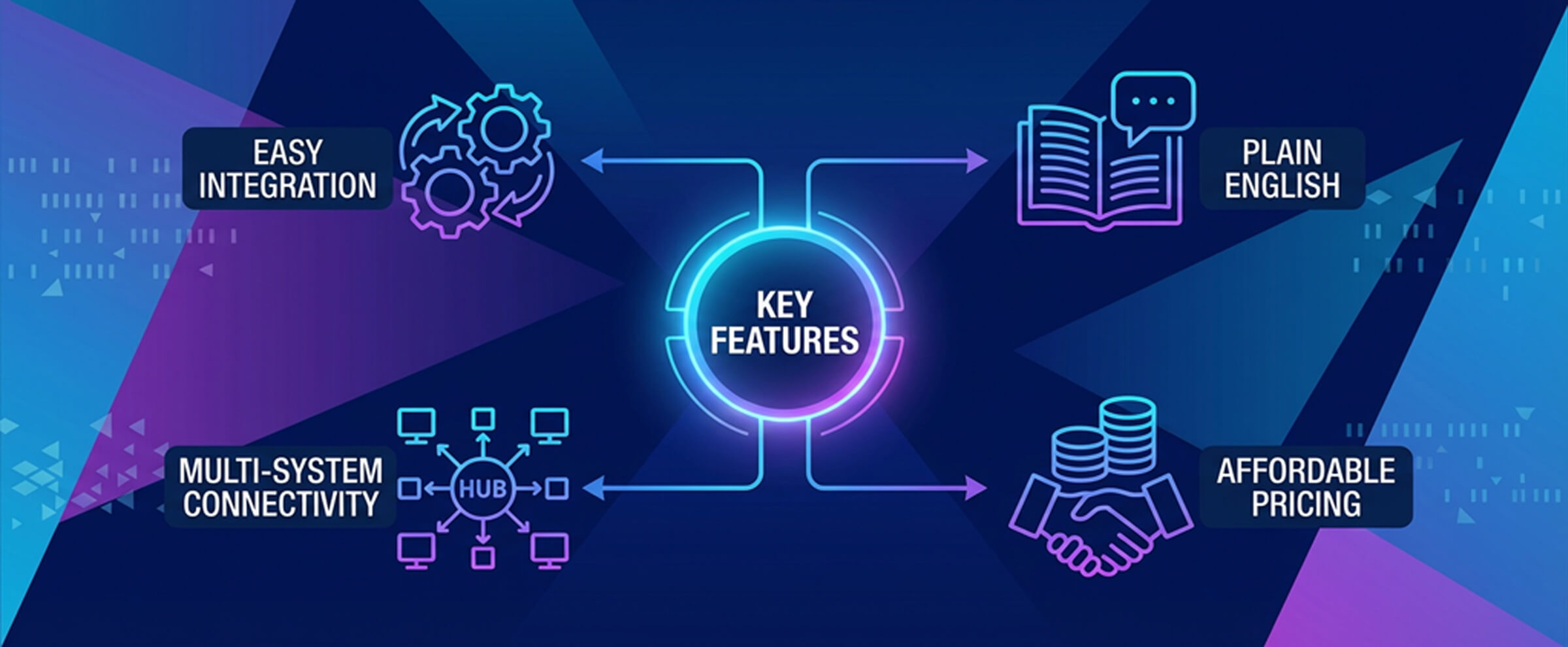
Not all AI business intelligence platforms are created equal. Here’s what actually matters:
Easy integration – You should be able to connect your business apps in minutes, not hire a consultant for weeks.
Plain-English queries – If you need to learn SQL or read a manual, it’s not really designed for business owners.
Multi-system connectivity – Any platform that only connects to one or two apps isn’t giving you the complete picture.
Affordable pricing – Enterprise BI costs $50,000+/year. Modern AI platforms for SMBs should run $150-500/month depending on your needs.
The Bottom Line
You’re already collecting the data. Your business systems track everything—sales, expenses, customer behavior, inventory, marketing performance.
AI-powered business intelligence just helps you use it.
Instead of:
- Spending hours creating reports manually
- Making decisions based on gut feel and incomplete information
- Discovering problems after the damage is done
- Wondering which marketing actually works
- Guessing at what next month will bring
You get:
- Instant insights from all your business data
- Decisions based on analysis of thousands of data points
- Early warnings before problems become crises
- Clear ROI on every marketing dollar
- Accurate forecasts that help you plan confidently
The question boils down to this: how much longer will you run your business without it?
See What AI Discovers About Your Business
Reading about AI capabilities is one thing. Seeing your own business data transformed into actionable insights is another entirely.
That’s why we built ROAI —an AI platform designed specifically for small and medium-sized businesses. We integrate with Hubspot, Quickbooks, Gmail, Outlook, Shopify, Stripe, Google Drive, Odoo, Paypal, Sharepoint and Woocommerce.
Here’s what you get:
- Simple integrations – Connect in under 60 seconds
- Automatic daily insights – Wake up to a dashboard showing what matters
- Plain-English questions – “Show me my most profitable products”
Connect your data and see what real insights AI discovers about your business.